publications
publications by categories in reversed chronological order. generated by jekyll-scholar.
2025
-
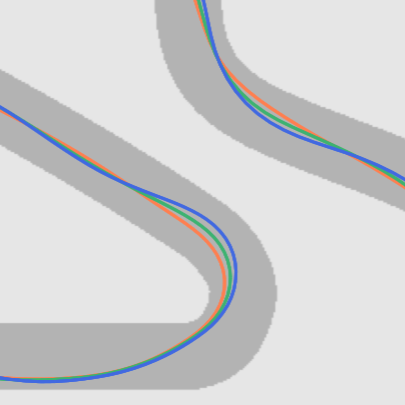 Context-Aware Model-Based Reinforcement Learning for Autonomous RacingEmran Yasser Moustafa and Ivana DusparicIn IEEE International Conference on Advanced Robotics (ICAR), 2025
Autonomous vehicles have shown promising potential to be a groundbreaking technology for improving the safety of road users. For these vehicles, as well as many other safety-critical robotic technologies, to be deployed in real-world applications, we require algorithms that can generalize well to unseen scenarios and data. Model-based reinforcement learning algorithms (MBRL) have demonstrated state-of-the-art performance and data efficiency across a diverse set of domains. However, these algorithms have also shown susceptibility to changes in the environment and its transition dynamics. In this work, we explore the performance and generalization capabilities of MBRL algorithms for autonomous driving, specifically in the simulated autonomous racing environment, Roboracer (formerly F1Tenth). We frame the head-to-head racing task as a learning problem using contextual Markov decision processes and parameterize the driving behavior of the adversaries using the context of the episode, thereby also parameterizing the transition and reward dynamics. We benchmark the behavior of MBRL algorithms in this environment and propose a novel context-aware extension of the existing literature, cMask. We demonstrate that context-aware MBRL algorithms generalize better to out-of-distribution adversary behaviors relative to context-free approaches. We also demonstrate that cMask displays strong generalization capabilities, as well as further performance improvement relative to other context-aware MBRL approaches when racing against adversaries with in-distribution behaviors.
-
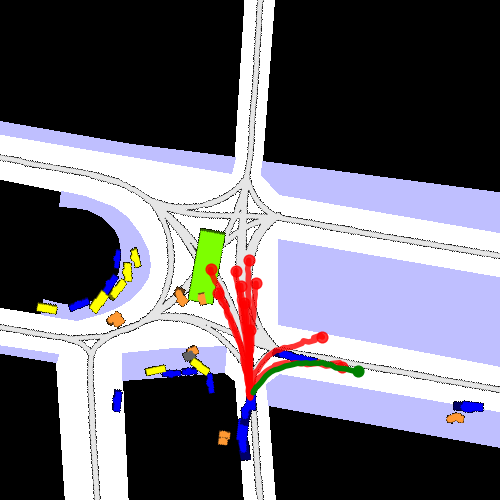 Road User Specific Trajectory Prediction in Mixed Traffic Using Map DataHidde JH Boekema, Emran Yasser Moustafa, Julian FP Kooij, and 1 more authorIEEE Robotics and Automation Letters, 2025
This paper studies road user trajectory prediction in mixed traffic, i.e. where vehicles and Vulnerable Road Users (VRUs, i.e. pedestrians, cyclists and other riders) closely share a common road space. We investigate if typical prediction components (scene graph representation, scene encoding, waypoint prediction, motion dynamics) should be specific to each road user class. Using the recent VRU-heavy View-of-Delft Prediction (VoD-P) dataset, we study several directions to improve the performance of the state-of-the-art map-based prediction models (PGP, TNT) in urban settings. First, we consider the use of class-specific map representations. Second, we investigate if the weights of different components of the model should be shared or separated by class. Finally, we augment VoD-P training data with automatically extracted trajectories from the 360-degree LiDAR scans by the recording vehicle. This data is made publicly available. We find that pre-training the model on auto-labels and making it class-specific leads to a reduction of up to 22.2%, 20.0%, and 18.2% in minADE (K=10 samples) for pedestrians, cyclists, and vehicles, respectively.